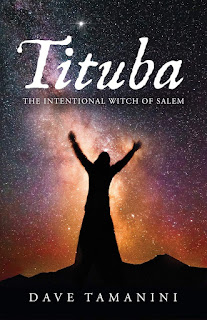
Tituba: The Intentional Witch of Salem by Dave Tamanini: A Book Review

Tituba: The Intentional Witch of Salem

Author: Dave Tamanini

Genre: Historical Fiction, Fantasy

Publisher: David F Tamanini

Release Date: 2020

Pages: 317

Source: Publisher/Netgalley in exchange for an honest review.

Synopsis: If you love historical fiction... come revisit Salem's terror in this provocative new telling of enslaved Tituba, no longer a caricature, but a fully human woman with magical powers.


     Come! Let Tituba cast its spell with a unique and tantalizing tale that explores the wild emotions driving accusations of witchcraft in 1692.

     A Promise and a Hope

     Enslaved Tituba has been faithful to a promise to her dying mama in Africa. She has appeased the masters from Barbados to Boston to Salem and waited for her magic.

     A Mother’s Agony

     When Tituba’s only son dies trying to escape slavery, her life changes forever. After enduring the crush only a mother can feel, she rages and turns to vengeance.

     Witches Tear into Salem

     The villagers see witches and demons everywhere. Their ministers say the Devil has sent them to steal souls. But they are wrong. It is Tituba—disobeying an ancient rule—conjuring terrifying images with magic that sparks the infamous witch hunts of 1692.

     A Woman’s Dilemma

     As neighbors accuse neighbors of witchcraft, hysterical trials follow. And Tituba gloats in her power. But when hangings begin, her conscience arises. Can she confront her secret crime? And when a chance for redemption presents itself, will she take it?

      My Review: Tituba retells the Salem Witch trials from Tituba’s perspective. Tituba was the first person to be accused of witchcraft in Salem. This novel paints Tituba as an actual witch and tells why she uses witchcraft. When the witchcraft trials begin and the hangings start, Tituba begins to feel remorse. Can Tituba ever be redeemed?


Tituba is a tragic character. She is a slave that works in a preacher’s household. Her preacher is cruel to her and makes her life miserable. Thus, she turns to witchcraft, and it makes her feel powerful. However, she feels remorse when she causes innocent people to die in the witchcraft trials. While I found myself empathizing with Tituba, I did not feel connected to her. I thought that she was not developed very well for she is mostly overshadowed by her master, Reverend Parris who I thought was more complex than she was. However, I did admire her role as a mother.


Overall, this novel is about choices, loss, and redemption. The characters were not really developed. However, I thought the author made Salem really come alive. He portrayed how superstitious the people of Salem were. Therefore, I found the setting to be the best part of the novel. The novel was also very slow in the beginning, but picked up pace during the witchcraft trials. Even though the author portrays Tituba as an actual witch, I don’t think she was historically. Still, I find this novel did justice to Tituba by showing her hardships. I recommend this book for fans of The Heretic’s Daughter, A Break with Charity, and The Sacrifice! Tituba is a novel that anyone who loves reading about the Salem Witchcraft Trials will not want to miss!


Rating: 3 out of 5 stars


This is the official book trailer of Tituba: The Intentional Witch of Salem:


Comments

Popular posts from this blog

Theodora: Actress, Empress, Saint (Women in Antiquity) by David Potter: A Book Review

Theodora: Actress, Empress, Saint (Women in Antiquity) Author: David Potter Genre: Nonfiction, Biography, History Publisher: Oxford University Press Release Date: November 4, 2015 Pages: 288 Source: Publisher/Netgalley in exchange for an honest review. Synopsis: Two of the most famous mosaics from the ancient world, in the church of San Vitale in Ravenna, depict the sixth-century emperor Justinian and, on the wall facing him, his wife, Theodora (497-548). This majestic portrait gives no inkling of Theodora's very humble beginnings or her improbable rise to fame and power. Raised in a family of circus performers near Constantinople's Hippodrome, she abandoned a successful acting career in her late teens to follow a lover whom she was legally forbidden to marry. When he left her, she was a single mother who built a new life for herself as a secret agent, in which role she met the heir to the throne. To the shock of the ruling elite, the two were married, and when Justinian...

Guest Post by Elisa DeCarlo: From Corsets to Chemises: Fashion as Liberation

  Today's guest writer is Elisa DeCarlo. Elisa DeCarlo has published two novels, Strong Spirits and The Devil You Say as well as The Abortionist's Daughter . Her work is also in a number of anthologies. Elisa has also written and performed a number of solo shows across the country. In 2013, the Exit Press will publish an anthology of her stage work. Elisa was born in Westchester, NY, and grew up there and in New York City. As an actress, she has performed in television, radio and film. In her guest post, Elisa DeCarlo talks women's fashion in the 1910s. Be sure to check out my review of The Abortionist's Daughter soon. Thank you, Mrs. DeCarlo. From Corsets to Chemises: Fashion As Liberation In The Abortionist’s Daughter , which is set in 1916, the evolution of the main character, Melanie Daniels, is not only shown by her thoughts actions, but also her clothes.  Since I am an obsessed fashion buff, I had to write about the clothes! Queen Victoria ...

Guest Post: The Ladies-in-Waiting: Lady Isabel Baynton by Alexandra Walsh

    Today's guest writer is Alexandra Walsh. She is the author of The Catherine Howard Conspiracy , which is a historical thriller surrounding the infamous Tudor queen. In this guest post, Mrs. Walsh discusses the life of Catherine's lady-in-waiting, Isabel Baynton. This post will be sure to fascinate fans of Tudor era. If you enjoy her post, please pick up a copy of The Catherine Howard Conspiracy ! Thank you, Mrs. Walsh! The Ladies-in-Waiting – Lady Isabel Baynton by Alexandra Walsh     One of the most enjoyable things about writing an historical novel is discovering the tiny details that make the period real on the page. While I was researching The Catherine Howard Conspiracy , I spent a great deal of time hunting out the life stories of the women who surrounded the young queen in order to create a group of realistic friends and confidants.       There are some well-known names linked with Catherine and her downfall: Lady Jane Boleyn,...